Choice Based Conjoint Analysis
The objective was to understand consumer preferences for consuming fish through choice-based conjoint analysis using various attributes and levels
As noted in the popular press government policies on the labeling of food products as
“genetically modified” is a controversial topic.
Little is understood in terms of consumer behavior with regards to such labels.
To help us understand consumer behavior in this space, I have collected choice-based conjoint data on consumer preferences. The attributes and levels for the study are as follows:

A factorial design was used to develop 9 profiles to be evaluated by consumers. Consumers are offered a binary (yes/no) design to the question "would they buy the profile?"
A sample of 109 consumers completed the survey.
For this model, I treated “salmon” as the baseline type and “farm-raised/genetically modified” as the baseline production method.
Then, I let the price enter the utility function linearly in tens of dollars and included an intercept term in the model.
Post that, I used the estimates of the model parameters to compute the predicted probabilities for each individual.
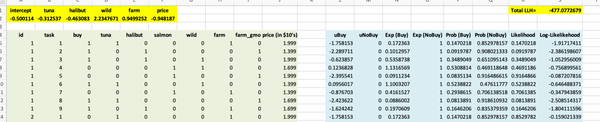
Lastly, I built the total log-likelihood function and used the solver function to find the parameter values that maximize the log-likelihood as seen in the screenshot below.
Next, I computed the derived importance of each attribute. We can see that "method" is collectively the most important attribute at ~69%

Since "method" is the most important attribute, I decided to find out how much more or less consumers are willing to pay if the method changes, keeping type constant.

We can see that consumers are willing to pay 23.57$/lbs more for wild relative to Farm-GMO and 10.02$/lbs more for farm relative to Farm-GMO
For the next part of the analysis, I assumed the market with the 4 products and an additional product with "none" as an option as seen below:

I used the logit rule to compute the share of respondents predicted to choose each option at the given prices. I wanted to find out what would happen to the share of "Farm Raised Salmon"(Product 4) if it becomes "Farm Raised and Genetically Modified" (still priced at $13.99)?

I used a similar process, found out the utilities and the share, and as it turns out the market share of product 4 was reduced by ~7% with the change mentioned above. Through this model, I can easily find out how market share would be impacted by any given change in these attributes and levels.